Blood/Blood Cells and Cellular Components ›› Lymphocytes ›› Abnormal
Lymphoblasts (e.g. Acute Lymphoblastic Leukemia: ALL)
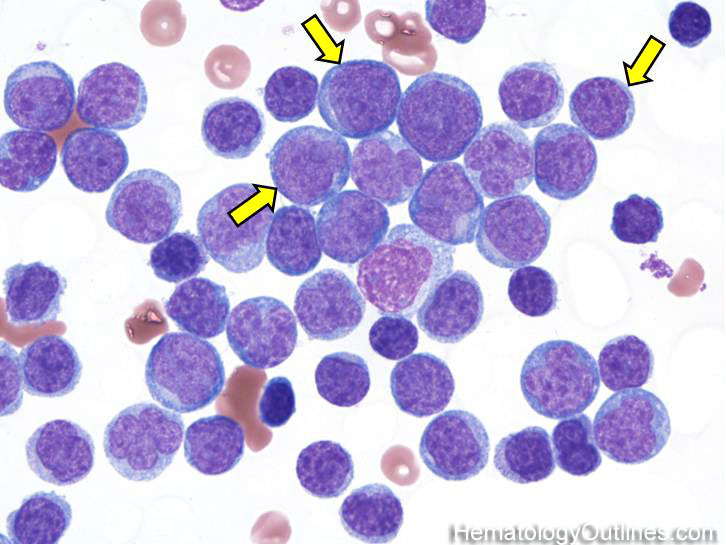

 ›Microscopic Features:
- 3-4x larger than a mature RBC
- High nuclear to cytoplasmic ratio
- Round Nucleus with immature chromatin (not clumped)
- Prominent nucleoli
- Cytoplasm is scant, light blue and lacks granules
 ›Normal % blood-PB, marrow-BM, lymphoid tissue-LN:
- PB: None
- BM: None
- LN: None
 ›May Resemble:
 ›Differential Diagnoses:
If in blood or increased numbers in bone marrow or tissue:
B-Lymphoblastic leukemia (B-ALL)
T-Lymphoblastic leukemia (T-ALL)
CML lymphoblastic Bast crisis (usually it's Myeloblast s but can sometimes be lymphoblasts)
B-Lymphoblastic leukemia (B-ALL)
T-Lymphoblastic leukemia (T-ALL)
CML lymphoblastic Bast crisis (usually it's Myeloblast s but can sometimes be lymphoblasts)
 ›Classic Immunophenotype:
- B-lymphoblasts
- CD19+
- CD10+
- CD20-
- CD34+
- TdT+
- -------------------------
- T-lymphoblasts
- CD3+
- CD7+
- CD34+
- TdT+
 ›Cartoon Image:

Click and drag for direct comparison
for direct comparison ›Misc:
Blasts cells cannot be reliably distinguished from each other based on morphology alone. The exception are blasts with Auer Rod(s) which are unique to abnormal Myeloblasts and abnormal promyelocytes as noted in some AMLs and APL
Note: Abnormal lymphoblasts can show immunophenotypic abberancies (e.g. the gain of myeloid markers)
Note: Abnormal lymphoblasts can show immunophenotypic abberancies (e.g. the gain of myeloid markers)