Primary Hematopoietic and Lymphoid Tissue ›› Bone Marrow ›› Lymphoid ›› T-cells ›› Abnormal
T-Lymphoblasts (Increased)
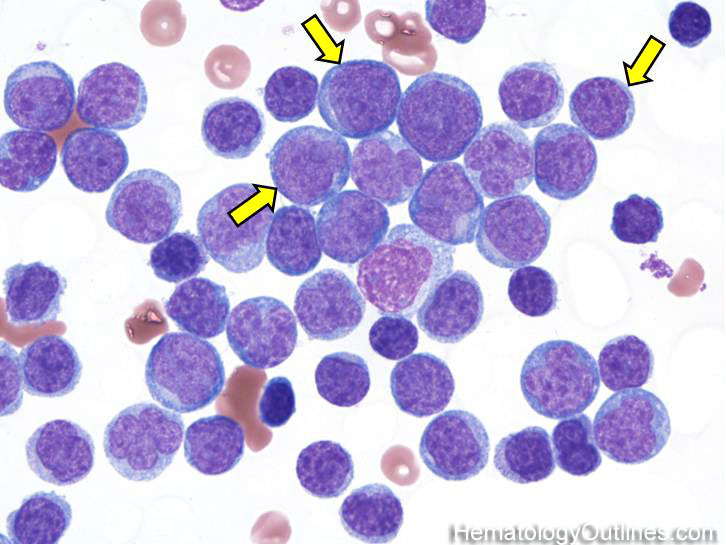

 ›Microscopic Features:
- 3-4x larger than a mature RBC
- High nuclear to cytoplasmic ratio
- Round Nucleus with immature chromatin (not clumped)
- Prominent nucleoli
- Cytoplasm is scant, light blue and lacks granules
 ›Normal % blood-PB, marrow-BM, lymphoid tissue-LN:
- PB: None
- BM: Rare (~1%)
- LN: None
 ›May Resemble:
 ›Differential Diagnoses:
If in blood or increased numbers in bone marrow:
T-Lymphoblastic leukemia (T-ALL)
Rarely some non-neoplastic conditions
T-Lymphoblastic leukemia (T-ALL)
Rarely some non-neoplastic conditions
 ›Classic Immunophenotype:
- CD3+ (cytoplasmic)
- CD7+
- CD34+
- TdT+
 ›Cartoon Image:

Click and drag for direct comparison
for direct comparison ›Misc:
Blasts cells cannot be reliably distinguished from each other based on morphology alone. The exception are blasts with Auer Rod(s) which are unique to abnormal Myeloblast {16}s and abnormal promyelocytes as noted in some AMLs and APL
Note: Abnormal lymphoblasts can show immunophenotypic abberancies (e.g. loss of T-cell antigens such as CD7, CD5 and CD2 or the gain of myeloid markers such as CD13, etc.)
Note: Abnormal lymphoblasts can show immunophenotypic abberancies (e.g. loss of T-cell antigens such as CD7, CD5 and CD2 or the gain of myeloid markers such as CD13, etc.)