Primary Hematopoietic and Lymphoid Tissue ›› Bone Marrow ›› Lymphoid ›› B-cells ›› Normal
Immature B-cell (Later Hematogone)
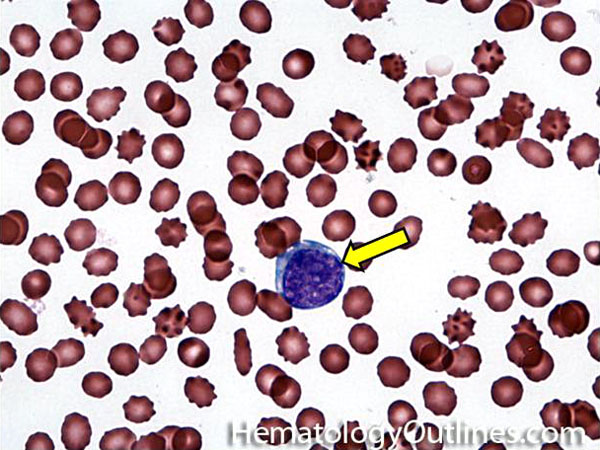

 ›Microscopic Features:
- 2-4x larger than a mature RBC (variable size given their variable stage of maturation)
- High nuclear to cytoplasmic ratio
- Round Nucleus with immature chromatin (not clumped)
- Nucleoli are present (specially on less mature stages) but less prominent than blasts
- Cytoplasm is scant, light blue and lacks granules
- Usually it is morphologically indistinguishable from a Lymphoblast
 ›Normal % blood-PB, marrow-BM, lymphoid tissue-LN:
- PB: None
- BM: Scattered
- LN: None
 ›May Resemble:
 ›Differential Diagnoses:
If in blood or increased numbers in bone marrow:
Maybe increased in newborns (not to be confused with acute leukemia)
May be seen in recovering bone marrows (e.g. post-treatment)
Acute Leukemia
Maybe increased in newborns (not to be confused with acute leukemia)
May be seen in recovering bone marrows (e.g. post-treatment)
Acute Leukemia
 ›Classic Immunophenotype:
- CD19+
- CD10+
- CD20+/-
- CD34-
- TdT-
 ›Cartoon Image:

Click and drag for direct comparison
for direct comparison ›Misc:
These are immature B-cells that are usually morphologically indistinguishable from lymphoblasts.
Hematogones are a immunophenotypically diverse group of immature B-cells (Earlier forms have less mature markers such as CD34 and TdT while the more mature forms lack CD34 and TdT and partially express CD20)
See the B-cell Maturation Diagram for more details
Hematogones are a immunophenotypically diverse group of immature B-cells (Earlier forms have less mature markers such as CD34 and TdT while the more mature forms lack CD34 and TdT and partially express CD20)
See the B-cell Maturation Diagram for more details