Primary Hematopoietic and Lymphoid Tissue ›› Bone Marrow ›› Myeloid ›› Erythroid (RBCs & Precursors) ›› Normal
Normal mature RBC
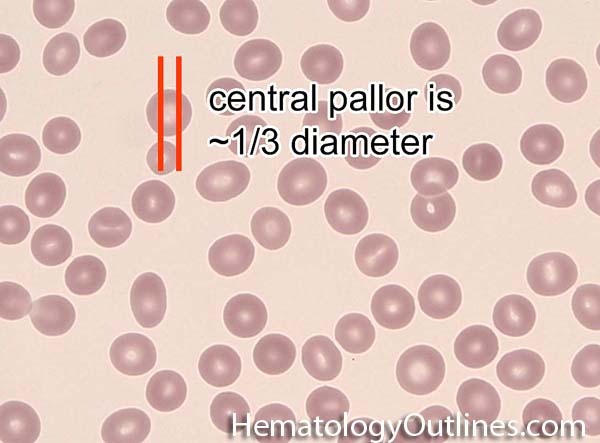

 ›Microscopic Features:
- Size 6-8 um, slightly smaller than a mature lymphocyte
- Lacks a nucleus
- Cytoplasm is pink-orange in color with a central pallor
- Central pallor is 1/3 the diameter
 ›Normal % blood-PB, marrow-BM, lymphoid tissue-LN:
- PB: Many
- BM: Many
- LN: Some
 ›May Resemble:
 ›Differential Diagnoses:
Increased in:
Reactive Erythroid hyperplasia
Post-erythropoietin therapy
Polycythemia Vera
Reactive Erythroid hyperplasia
Post-erythropoietin therapy
Polycythemia Vera
 ›Classic Immunophenotype:
- CD45-
- CD117-
- CD235a (Glycophorin A) +
- CD71-
 ›Cartoon Image:

Click and drag for direct comparison
for direct comparison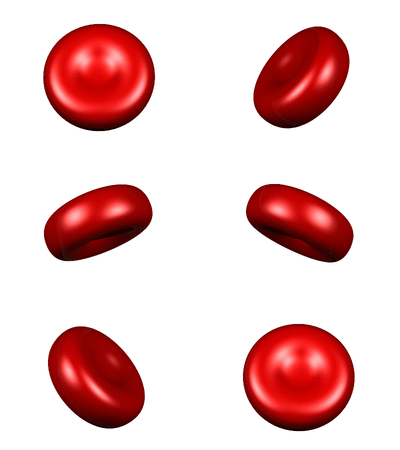
3D Representation
 ›Misc:
Normal mature RBCs are normocytic (MCV 80-100) and normochromic (1/3 central pallor).Its main function is to carry oxygen through its hemoglobin molecules.
Note: As Erythroid precursors mature, the color of their cytoplasm changes from blue to gray to red-orange (this is due to the increase in the number of hemoglobin molecules within the red cells as they mature). Additionally, the nucleus of the red blood cell will become more dense as it matures, eventually excreting from the cell forming the mature RBC.
Note: As Erythroid precursors mature, the color of their cytoplasm changes from blue to gray to red-orange (this is due to the increase in the number of hemoglobin molecules within the red cells as they mature). Additionally, the nucleus of the red blood cell will become more dense as it matures, eventually excreting from the cell forming the mature RBC.