Blood/Blood Cells and Cellular Components ›› Eosinophils and Basophils ›› Eosinophils ›› Abnormal
Eosinophil (Increased)
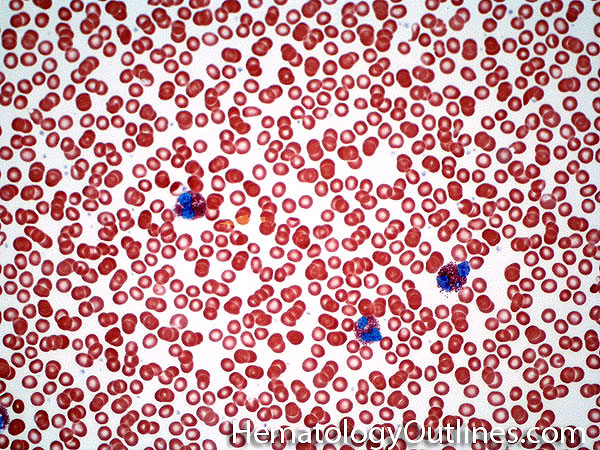

 ›Microscopic Features:
- 2-3x larger than a mature RBC
- Low nuclear to cytoplasmic ratio (more cytoplasm than nucleus)
- Nucleus is mature and usually with 2 lobes connected by thin chromatin filament
- Nucleoli are absent
- More cytoplasm with only secondary granules
- Secondary (specific) granules are Eosinophilic (Red-Orange)
 ›Normal % blood-PB, marrow-BM, lymphoid tissue-LN:
- PB: Scattered (4th most common WBC in blood, after neutrophils, lymphocytes and monocytes)
- BM: Rare scattered
- LN: Rare to None
 ›May Resemble:
- Segmented Neutrophil
- Pseudo-Pelger Huet Neutrophil
- Band Neutrophil
- Neutrophil with toxic granules
- Promyelocyte
- Basophil
 ›Differential Diagnoses:
Increased in:
Allergy-related (e.g. Asthma)
Drug reactions
Invasive parasitic infections
Myeloproliferative neoplasms
Hodgkin's and non-Hodgkin's lymphomas
Autoimmune disorders (some)
Allergy-related (e.g. Asthma)
Drug reactions
Invasive parasitic infections
Myeloproliferative neoplasms
Hodgkin's and non-Hodgkin's lymphomas
Autoimmune disorders (some)
 ›Classic Immunophenotype:
- CD45dim+
- High SSC (Side light scatter)
- CD13dim+
- CD16-
- CD15dim+
 ›Cartoon Image:

Click and drag for direct comparison
for direct comparison ›Misc:
Increased amounts are commonly associated with:
Drugs
Allergy
Infection (specially invasive multicellular parasites)
Neoplasm (e.g. Myeloid neoplasms such as some AMLs or MPNs)
Idiopathic
Drugs
Allergy
Infection (specially invasive multicellular parasites)
Neoplasm (e.g. Myeloid neoplasms such as some AMLs or MPNs)
Idiopathic